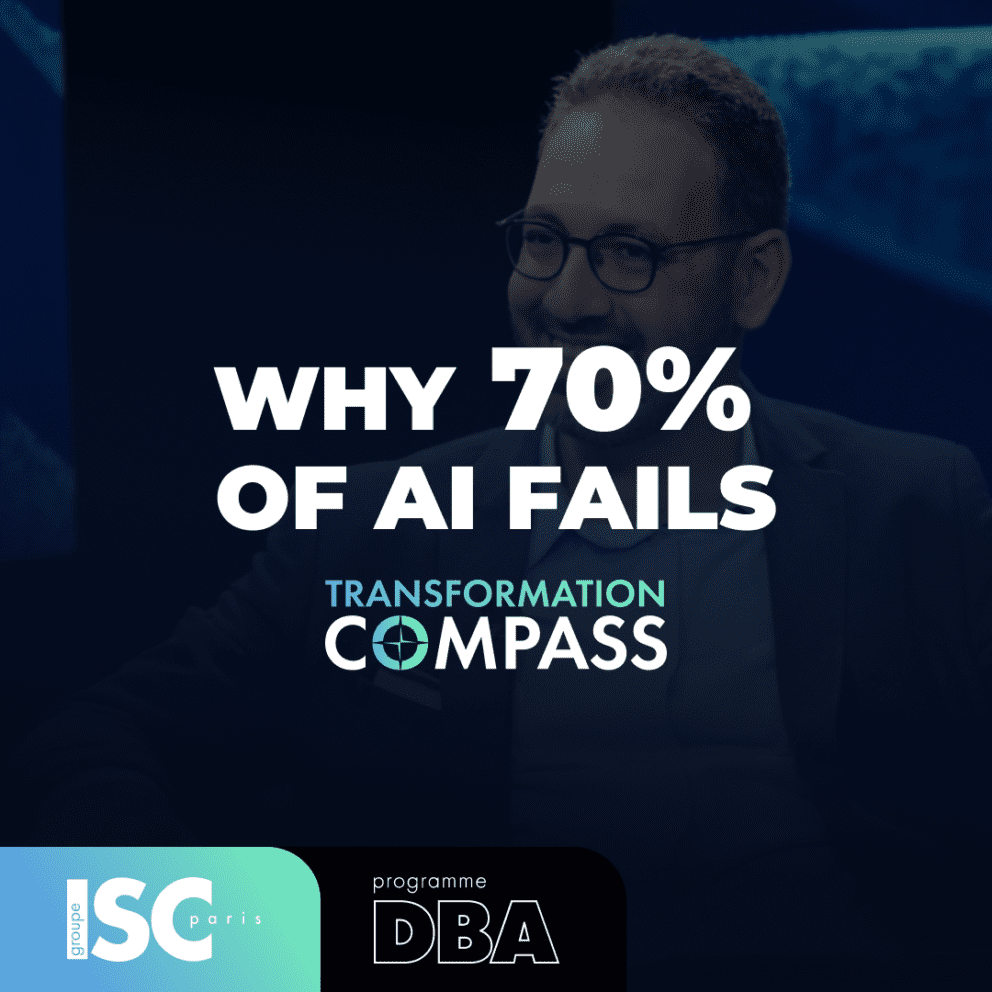
In conversations with senior executives across Europe, the same number keeps surfacing: 70%. Not the share of companies investing in AI. The share of digital transformations that fall short of their stated objectives.
That figure is the starting point of the first episode of Transformation Compass, the podcast of ISC Paris’s DBA program. Host Nabil Ghantous — director of the program — sits down with Jean-Christophe Lessie, Partner at Boston Consulting Group, former CIO of Veolia (CIO of the Year 2019), and ISC Paris alumnus, to make sense of why so many AI initiatives stall, and what the minority that succeeds does differently.
The conversation is not about technology. It is about why the most expensive part of an AI initiative has almost nothing to do with the algorithm. What follows is a synthesis for senior leaders who haven’t yet listened — and a reason to.
Lessie’s central frame is deceptively simple.
« You can spend 10% of your effort just designing the algorithm, 20% of the effort on technology and data platforms, and the rest — 70% — must be dedicated to transforming people, processes, and the organization. »
Most organizations invert that ratio. They invest visibly in the 30% — vendors, tools, data platforms — and assume the 70% will follow. It doesn’t.
Lessie’s example is precise. « You can build the smartest AI tool in the world. If people don’t use it, it’s useless. » A predictive maintenance system with 95% accuracy is worth nothing if the maintenance crew on the ground does not trust it. The value disappears at the point of non-adoption.
Hence the second principle, and it is the hinge of everything that follows: « People embrace AI when they trust AI. Trust is really key. »
There is a distinction Lessie makes that is easy to miss but worth sitting with — the difference between productivity and transformation.
« One salesperson sending emails quicker is helpful, but very limited. Now imagine your entire sales process transformed by AI — finding leads, personalizing pitches, predicting what customers want. This is when productivity turns into revenue growth. »
The point is not that small pilots are useless. Lessie explicitly recommends starting small — what he calls « pockets of excellence. » The problem is that most organizations never leave that stage. They accumulate experiments without ever embedding any of them deeply enough to change the operating model.
The data supports the diagnosis. « 25% of companies that truly achieve significant value from AI focus deeply on very few use cases — one, two, or three topics maximum — rather than having small experiments everywhere. »
Nabil Ghantous confirms the same pattern from his own research with small and medium-sized companies. « I see a lot of the time trying to be all over the place with AI, and at the end of the day there’s very little result because of this lack of focus. »
For senior leaders, the takeaway is uncomfortable. Most AI portfolios are not strategic. They are an aggregation of pilots, each defensible in isolation, none transformative in aggregate. The 25% that create real value have one thing in common: they made the hard choice of what NOT to do.
One of the most counterintuitive moments in the episode is when Lessie reframes the legacy versus digital-native debate.
« Digital natives are like sports cars — born with AI inside, it’s part of their DNA, from infrastructure to the boardroom, everything is data-driven. »
« Legacy companies are more like reliable and tough SUVs. Not designed for speed, built for endurance. Burdened with old systems, outdated software, and most of the time a risk-averse culture. »
The metaphor doesn’t end where most executives expect.
« They have a huge amount of historical data. A very large footprint. They know their customers deeply because they’ve had relationships with them for decades. If they build on those competitive advantages, they can leapfrog younger companies. I’ve seen traditional businesses out-innovating startups once they address their cultural barriers. »
The Veolia case is Lessie’s own demonstration. « We launched the Zero Data Center strategy — turning off 80 data centers around the world and going full cloud for the entire company. This was in 2015. » The technical shift was straightforward. The people shift was the work. Lessie’s team built an internal marketplace where 80+ business units could freely select cloud solutions — « we empowered the local teams, leaving the choice to embrace it or not. » Adoption climbed to over 60%.
His underlying point is a sentence that sounds simple and is not. « You can’t change anything if employees don’t understand the why. ‘What’s in it for me?’ This is a clear question everybody’s asking when you start to change. »
Late in the conversation, Lessie offers what is probably the most original frame of the episode — and one Nabil suggests he should trademark on the spot.
« I call it organizational acupuncture. You identify the pain points and you press on it until it doesn’t hurt anymore. You finger-point your outdated systems, your skill gaps, your silos — and you solve them step by step. »
The metaphor matters because it reframes what executive transformation actually is. Not a top-down program. Not a culture deck. A surgical sequence: locate the friction, apply pressure, move on. The job of senior leadership in the AI era is not to set a vision and outsource execution. It is to know which pressure point to press next — and to keep pressing it long enough that the system reorganizes itself around the change.
The full episode goes further: into the productivity-versus-revenue distinction, the role of leadership visibility in driving adoption, and the joke about legacy systems that Lessie delivers with the timing of someone who has seen too many migration projects (« Do you know why God created the world in seven days? It’s because there was no legacy system. »).
For senior leaders trying to make sense of where to actually invest their attention in 2026, this conversation is a useful corrective. It moves the debate from technology to leadership — which is where the 70% lives.
The shift Lessie describes — from technology problem to leadership problem — connects directly to a broader question: what cognitive capabilities will senior leaders need in an AI-driven era? We explored it in depth in why executives need research skills in the AI era. The same human thread runs through the companion piece on the human factor that decides every AI transformation. And the ISC Paris DBA, which produces this podcast, is built around that same intersection of executive practice and applied research.