Ask a senior executive considering further education and the same letters keep coming back: MBA, EMBA, PhD, DBA. Most articles will tell you these are equivalent paths up a similar mountain. They are not. They are different mountains, with different summits — and most experienced executives are choosing the wrong one for the wrong reasons. The question isn’t which is best. It’s which is built for where you actually want to go.
That is the question this article addresses, with the rigor the choice deserves. DBA vs MBA vs PhD is not a neutral comparison. Each format was designed for a specific career stage and a specific intellectual ambition. Choosing the one that does not match yours costs years of your career and a six-figure investment that produces less than it could. So let’s look at each format honestly — including their real strengths — and at the end draw the conclusion the evidence supports.
Ask an experienced leader who is weighing more education and the same letters keep coming up: MBA, EMBA, PhD, DBA. Most articles treat them as four routes up the same mountain. They are not the same mountain at all. Each one leads somewhere different, and a lot of capable people pick the route that doesn’t match where they are actually trying to go. The useful question isn’t which degree is best in the abstract. It is which one fits the direction you have already set for yourself.
DBA vs MBA vs PhD isn’t a neutral comparison. Each format was built for a particular career stage and a particular kind of ambition. Pick the one that doesn’t match yours and you lose years, plus a six-figure investment that returns less than it should. What follows looks at each one, real strengths included, before getting to a recommendation.
You did your MBA more than a decade ago. It opened doors and gave you a shared language with the people you work alongside. It did its job.
Then, at some point, the question quietly returns. Not as a regret, but as something more specific: what would actually push me past the next threshold, professionally and intellectually?
You are not looking to relearn what you already do well. You have run teams through good quarters and bad ones, carried real responsibility for results, and been part of the decisions that shaped where your organization went.
And still, a plateau is forming. The next steps – a board seat, advisory work, high-end consulting, teaching, or a move into work where your judgment carries more formal weight – ask for something that experience on its own no longer guarantees.
At that point it stops being a question about education. It is really about who you want to become next.
The answer decides which degree, if any, is worth your time. Most articles on the subject skip straight past it.
Three credentials keep coming up, and each was built with a particular candidate in mind. Treating them as versions of the same product is the first mistake.
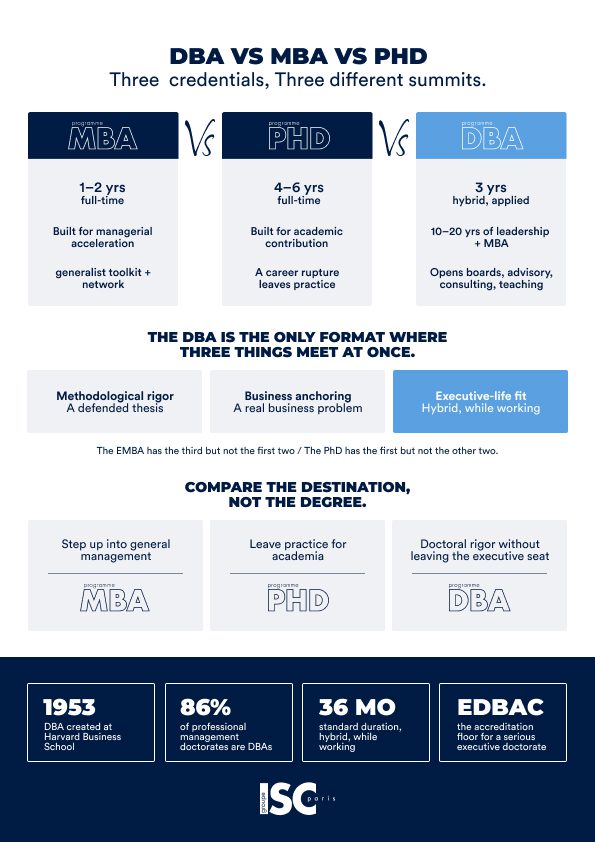
The MBA is the most familiar of the three: one or two years, often full-time, taken mid-career, built around the case method and a generalist curriculum. It turns out a credible manager with a solid toolkit and a strong network.
The Executive MBA is its older sibling – the same content compressed into eighteen months to two years, part-time, built around the schedules of experienced managers who never did a full MBA. That is who it is calibrated for, and it accelerates their vocabulary, network, and credibility. If you already hold an MBA and have been operating at a senior level for ten or more years, you have covered much of that ground already.
If you did an MBA early on and have spent the years since applying its frameworks at scale, the EMBA being a good program isn’t really in doubt. It is. The real question is whether it is built for the threshold you are trying to cross now.
The PhD is a different animal: four to six years, full-time, often with a stipend, designed to produce researchers who will spend their careers contributing to academic theory. The output is a dissertation that adds something genuinely new to the literature of a field, read by other academics, advanced through journals, validated through peer review.
It is a remarkable format, and it has produced most of what the business profession knows. It is also a clean break from the career you have now.
To do a PhD, you stop being a practitioner and become a researcher whose first loyalty is to an academic field. That is a worthwhile life, but it is not the one for someone who wants to stay in practice while building the intellectual depth to operate at a higher level.
If you want to leave management and become an academic, the PhD is the right call. If you want to keep the executive seat and add researcher to it, the PhD doesn’t allow for that. It asks you to change identity completely.
The DBA – Doctorate of Business Administration – is the one most experienced leaders find late, usually after they have ruled out the other two.
It was first offered in 1953 at Harvard Business School as the first applied business doctorate, a doctoral degree built for practitioners who already had real experience behind them. Seventy years on, it is the most widely offered professional doctorate in management in the world. In DBA Compass’s global survey of professional management doctorates, 86% of those doctorates are DBAs rather than PhDs. The format dominates the executive doctorate space because that is exactly what it was built for.
Three years of structured coursework, applied research, and a defended doctoral thesis. Ten or more years of professional experience is the usual expectation. The format is hybrid, so it fits around an active career. And the thesis is built on a real business problem, usually one inside your own organization, sector, or field of expertise.
Rather than pulling you out of practice, a DBA is meant to deepen it.
If that sounds like you – experienced, an MBA already behind you, the question of what comes next clearly forming – this is the format that was built for your situation.
Most experienced leaders weighing more education get nudged toward the EMBA almost on reflex. « It’s executive, so it’s for you. » That sounds logical, but it doesn’t hold up.
The EMBA is an excellent program for someone who hasn’t done an MBA and is still climbing. It teaches the frameworks, widens the network, and sharpens the financial vocabulary. For a manager stepping into executive responsibility for the first time, it is well calibrated.
But if you already hold an MBA and have been operating at a senior level for over a decade, a good part of what the EMBA offers will revisit frameworks you have already internalized – and applied at a scale many of your classmates haven’t reached yet. That isn’t nothing: a strong cohort, a fresh network, or a specific gap you want to close can still justify it. For a deeper intellectual shift, though, the marginal gain tends to be thinner than the cost.
The trap is that the EMBA looks like the safe choice. It is familiar, it is faster, and it doesn’t carry the intimidating weight of the word « doctorate. » For someone unsure whether they have the academic profile for doctoral work, and plenty of people underestimate themselves here, the EMBA can become a quiet way to avoid the question that actually matters.
That question isn’t « can I do a doctorate? » It is « does my next chapter need the kind of rigor only a doctorate builds? » If the answer is yes, then the EMBA, however good, is the wrong tool for the threshold ahead.
The DBA is the only format that brings three things together at once. You can find each one on its own elsewhere. The combination is much harder to find.
Methodological rigor. A DBA ends in a doctoral thesis, which means forming a hypothesis, designing the research, gathering and analyzing data, surviving peer review, and defending the work in person. Once you have done that, it stays with you. It changes how you read a study, weigh a data point, and build an argument in front of a board or an investor. It ties straight into the cognitive capabilities experienced leaders need in the AI era, and why those have moved from optional to defining.
Business anchoring. The DBA thesis is applied. It is built around a real problem, usually one inside your own organization, sector, or field. The research isn’t abstract; it produces knowledge you and your industry can use right away. That is the structural difference from a PhD, where the question is chosen for what it contributes to theory rather than for what it does in practice.
Compatibility with working life. The DBA assumes you stay professionally active. It runs on a hybrid format with scheduled seminars, one-on-one supervision, and deliberately small cohorts. Thirty-six months is the standard length, and it can extend when life demands it. No career break required.
The EMBA gives you the third element without the first two. The PhD gives you the first without the other two. The DBA is where all three meet, and that overlap is what makes it the one workable doctoral path for a leader who intends to keep working.
Of course, that structural advantage only counts if the format genuinely fits your life, which is the question behind whether you can do a DBA while working full-time.
The mistake most people make here is comparing the degrees to each other. A good decision starts from the destination, not the format.
If the five-year horizon includes joining boards or building an advisory practice at the level where intellectual credibility opens doors that experience alone does not, the DBA aligns. Being able to point to peer-reviewed research, a defended thesis, and doctoral-level method is what increasingly separates a board candidate from the hundreds of similarly experienced people chasing the same seats.
If the five-year horizon is the operational summit – running a larger organization, sitting on the executive committee of a listed group – the DBA isn’t strictly necessary. Experience, network, and the right strategic move count for more. An EMBA can speed things up if there are specific gaps. The DBA may add intellectual weight, but it isn’t the most efficient single instrument for that goal on its own.
If your horizon includes a move into teaching, into hybrid academic-executive roles, or into the kind of consulting where the edge is research-grade rigor rather than experience alone, the DBA aligns. The PhD would also work, but at the price of leaving the executive seat that gives your perspective its value in the first place.
If your horizon is launching a high-end consulting firm or advisory practice where the premium positioning rests on intellectual differentiation, a DBA opens a pricing tier an MBA-credentialed consultant can’t easily reach. Clients pay more for demonstrated research depth than they do for experience.
And if your answer to where you want to be in five years is still forming, which is more common at this stage than most articles admit, the DBA has a quietly useful property: it opens up the range of paths you can credibly move into, rather than narrowing them.
In the end it comes down to where each path leads, and the career outcomes DBA graduates actually report tell a different story from the brochure promises of most executive programs.
The right answer depends on who you are.
Early-career and on a management track? The MBA. Mid-career, senior in your function but without an MBA and moving toward general management? The EMBA. Planning to leave practice and contribute to academic theory full-time? The PhD.
And if you are an experienced leader – ten or more years behind you, an MBA already in hand, asking what would push you past the next intellectual and professional threshold – the DBA is the closest fit, both structurally and in the numbers. Not for prestige, but because it was designed for this exact stage and this exact ambition.
It sits where rigor and relevance meet, which is rarer than it sounds. Seventy years of refinement have kept both ends together: the discipline of a doctorate defended in front of academic peers, and research aimed at the business problems you have spent a career trying to solve. According to Campus France figures on the 2020 doctoral cohort, measured three years after graduation, 94% to 95% of doctorate holders employed in France hold executive-level (cadre) positions – a useful signal of how a doctorate positions graduates in the market, academia aside.
What separates a serious DBA from a marketing exercise is the program itself: the faculty’s research output, the methodological rigor, the makeup of the cohort, and how genuinely applied the research is. The Executive DBA Council (EDBAC), founded in 2011, publishes quality criteria along these lines for executive doctoral programs. Meeting them doesn’t guarantee a program fits you, but falling short of them is usually where the credential starts to lose its meaning.
None of this makes the DBA the right answer for everyone. The comparison ends where it began: with the question of what you want to become next. The degree is only ever a means to that. If your answer points toward research-grade credibility layered onto a career you intend to keep, the DBA is the format built for it – and the surest way to judge any particular program is to read its curriculum against the direction you have already set.